

Most marketers run a campaign “targeted to the ideal customer profile.” Most sales teams claim their outreach is ICP-based. Ask five people on that same team to define it out loud, and you will get five different answers.
Most ideal customer profiles describe a type of company: industry, headcount, geography, maybe revenue. This tells sales who could buy. It rarely says who will buy soon, stay long, or grow fast.
The fix is to build it backwards, starting with the customers already won instead of a hypothetical description of who might fit.
Get this right, and reps spend time on accounts likely to close, marketing targets the right list, and accounts convert faster because reps already know why they are worth the call. Done properly, it produces three concrete things: a filter sales can run, a contact to call inside the account, and a reason to call now.
What Is an Ideal Customer Profile?
An ICP (Ideal Customer Profile) represents the type of organization from which a company will obtain its greatest customers. The individual within that organization who would be most interested in purchasing your products or services would be referred to as a “buyer persona.” They have a job title, they have priorities, and they experience problems every day.
A target Market is all potential buyers for a business, while an ICP represents a subset of the target market that provides the best fit for a specific product or service; it includes organisations for which the product has proven successful for customer retention and account growth. ABM programs operate under this definition of ICP, as without defining ICP, there are no accounts to target.
Also Read: How to Create an Ideal Customer Profile for Your B2B Business
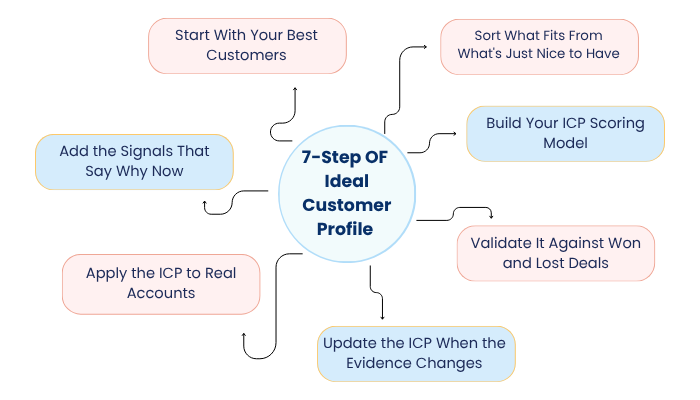
Step 1: Start With Your Best Customers
Teams often start with the wrong question: which companies could buy from us? A sharper question looks at current customers directly. Which ones brought the most revenue? Which ones stayed the longest? Which ones grew the most and cost the least to sell to? Get those top 10-20 customers identified first.
You will quickly identify the “obvious” characteristics of your top customers:
Industry, size, revenue, geography
But what about the other important characteristics?
- Business model and technology already in use
- Team structure and growth rate
- Hiring pace and funding history
- Deal size, sales cycle length, and retention
Company and firmographic data fill this gap since CRM systems typically do not contain complete information about each of the firms you have done business with. Once you have your list of top customers, you need to figure out which of the above characteristics are good indicators of fit.
Also Read: Future of B2B Marketing: Insights and Statistics
Step 2: Sort What Fits From What’s Just Nice to Have
Let’s say you have two accounts. Each fits your ideal customer profile (ICP) for all three factors, like industry, head count, and geography. However, account A has been a customer for several years and uses the current technology from the same vendor as you. They are not planning on buying anything new. Account B looks like it would be a poor candidate for your company based on what you see about their business; however, they recently added thirty employees, switched vendors, and have created a department that directly supports the use of your product. Even though account B does not look good on paper, it is most likely going to make a purchase soon.
Fit criteria and timing criteria answer different questions, and mixing them up is why a well-built ICP never gets used.
Must-haves eliminate an account from consideration immediately.
- Industry
- Geography
- Company size
- Business model
If an account fails one of these, it comes off the list.
Strong-fit criteria add additional weight to the overall score of an account that has already met the must-have criteria. The strong-fit criteria include the following:
- Technology stack
- Growth rate
- Job hires
- Team size
Another critical factor that is frequently overlooked is the problem(s) that your top customers were experiencing prior to purchasing your solution. When this type of problem is repeatedly mentioned in win notes, consider including it as a strong-fit criterion.
Two separate questions decide fit, and different data answers each. Company and firmographic data, plus technographic data, point to which accounts fit. Job title data points to who to call inside that account.
Step 3: Add the Signals That Say Why Now
A company can match on every count and still go quiet this week, simply because nothing in its situation has moved lately. A hiring surge shows up in job posting data. A funding round shows up in funding data. Active research shows up in intent data.
61% of B2B buyers now prefer a rep-free buying experience (Gartner, 2025 survey of 632 B2B buyers). Most of the research happens before an account ever contacts a rep, which is why intent data is often the only signal that shows an account is already looking.
Fit and timing together tell a rep whether an account is worth calling right now, so the two belong in a single score.
Step 4: Build Your ICP Scoring Model
A checklist can surface hundreds of accounts that technically fit. A score is what narrows that list down to the accounts that deserve a call first, the same way lead scoring narrows a list of contacts, just applied at the account level instead of the contact level.
The table below works as an example. Build the formula from your own numbers.
Replace each number with data from your own closed-won and closed-lost accounts.
Also Read: The Definitive Guide to B2B Account Scoring
Step 5: Apply the ICP to Real Accounts
Until it runs against real accounts, a score is just a model. Filter the account list to the ones that clear the must-haves and score well, and sales ends up with a usable list to work with instead of a theoretical one.
Run the model against your account list and this is what qualifies: SaaS companies, 200 to 1,000 employees, North America, using Salesforce, hiring for sales roles, with a recent growth signal. Each condition narrows the list further, and what survives is the list worth working on first.
Also Read: 10 Ways Guaranteed to Help your B2B Lead Generation Efforts
Step 6: Validate It Against Won and Lost Deals
A callable list still needs proof it works, and that is the step most teams skip.
Pull three groups: closed-won, closed-lost, and any poor-fit accounts that entered the pipeline anyway, then score all three the same way. If closed-won and closed-lost land at similar scores, the model is not telling good accounts from bad ones. If the poor-fit accounts score high too, a must-have criterion is set too loose. Either way, the results show exactly which criteria carry too much weight or too little.
This is usually where the problem shows up: the highest-scoring accounts often are not the ones that renewed, showing exactly which criteria need adjusting.
Keeping it that way just means watching for the right triggers.
Step 7: Update the ICP When the Evidence Changes
Skip the quarterly calendar reminder. Update the ICP when something meaningfully shifts:
- Your best segment changes
- Win rates start splitting between segments
- Deal size moves
- Retention differs by segment
- A new product launches
- The sales cycle changes
- A new segment starts beating your current one
Not every ICP problem traces back to new evidence, though. Sometimes it is simply a matter of scope.
When Your ICP Is Too Broad
“B2B companies with 100 or more employees” is a market description, too broad to function as a profile. A rep working from that list ends up filtering out weak accounts instead of calling on strong ones.
When Your ICP Is Too Narrow
If the whole addressable market turns up twelve accounts, one criterion is probably set too tight, so widen it before touching anything else.
Ideal Customer Profile Checklist
- Analysed your highest-value customers, not the full customer base
- Compared successful accounts against unsuccessful and lost ones
- Identified common firmographic traits across the strongest accounts
- Identified technology patterns among them
- Defined geographic boundaries
- Identified the buyer roles that influence a purchase
- Added business-growth signals like hiring and funding
- Defined the timing triggers worth acting on
- Built a scoring model weighted from your own data
- Converted the profile into a target-account list
- Validated it against closed-won and closed-lost accounts
- Set clear conditions for when to revisit it
An ICP built this way holds up because it comes from accounts that were already bought, rather than a guess about who might. Score it, test it against the deals that closed, and revisit it when the evidence shifts. The result is a filter sales trust, a name worth calling, and a reason to call today.
Frequently Asked Questions
What’s the difference between an ICP and a buyer persona?
An ICP is the company-level filter from Step 1 and Step 2. A buyer persona is the person you would call once that filter picks the account: their title, priorities, and daily problems. Most sales teams need both, working together rather than as substitutes.
How is an ICP different from a total addressable market (TAM)?
TAM is the full size of a market, every company that could theoretically buy what you sell. An ICP is a small slice of that TAM, narrowed down to the accounts that convert, stick around, and grow. TAM answers how big the opportunity is. An ICP answers who to call first.
Where do you get the firmographic, technographic, and intent data to build an ICP?
Most of it lives outside a CRM by default. BizProspex provides the firmographic, technographic, job title, hiring, funding, and intent data behind Steps 1 through 3 above.
How many criteria should an ICP have?
Fewer than most templates suggest. Step 2 covers this directly: a handful of must-haves, a few strong-fit criteria, and a small set of timing signals from Step 3 are usually enough. More criteria make the ICP harder to use, while accuracy tends to hold steady.
Can a business have more than one ICP?
Yes, especially if it sells more than one product or serves genuinely different segments. This is one of the shifts listed in Step 7: win rates start splitting between segments, usually the first sign that a single ICP no longer fits.
How do you build an ICP with limited closed-deal history?
Early-stage companies often have too few closed accounts to spot reliable patterns. Lean harder on firmographic and technographic fit criteria from Step 2, borrow timing signals like funding and hiring data from Step 3, and treat the model as a hypothesis. Revisit it as soon as there is enough closed-deal history to run the validation step in Step 6.
What’s the fastest way to validate an ICP?
Run Step 6: score closed-won and closed-lost accounts against the model. Similar scores across both groups mean the criteria or weights need fixing before building a target list from them.