
Data Scrubbing Services for Cleaner, More Reliable Business Records
Clean and Accurate Data to Improve Accuracy, Reduce Waste, and Boost Performance
Duplicate entries, inconsistent fields, outdated details, and formatting errors can make business databases harder to manage and less useful for decision-making. BizProspex provides professional data scrubbing services to identify and address these issues across CRM systems, customer databases, and B2B records. Our approach combines defined cleansing rules, technology-assisted checks, and expert review to help organisations improve data consistency while preserving important information. From CRM data scrubbing to large-scale business data scrubbing, each project is tailored to the structure of your records, your data quality requirements, and the systems that depend on them.
A+
27001
YRS
A+
27001
YRS
What Is Data Scrubbing?
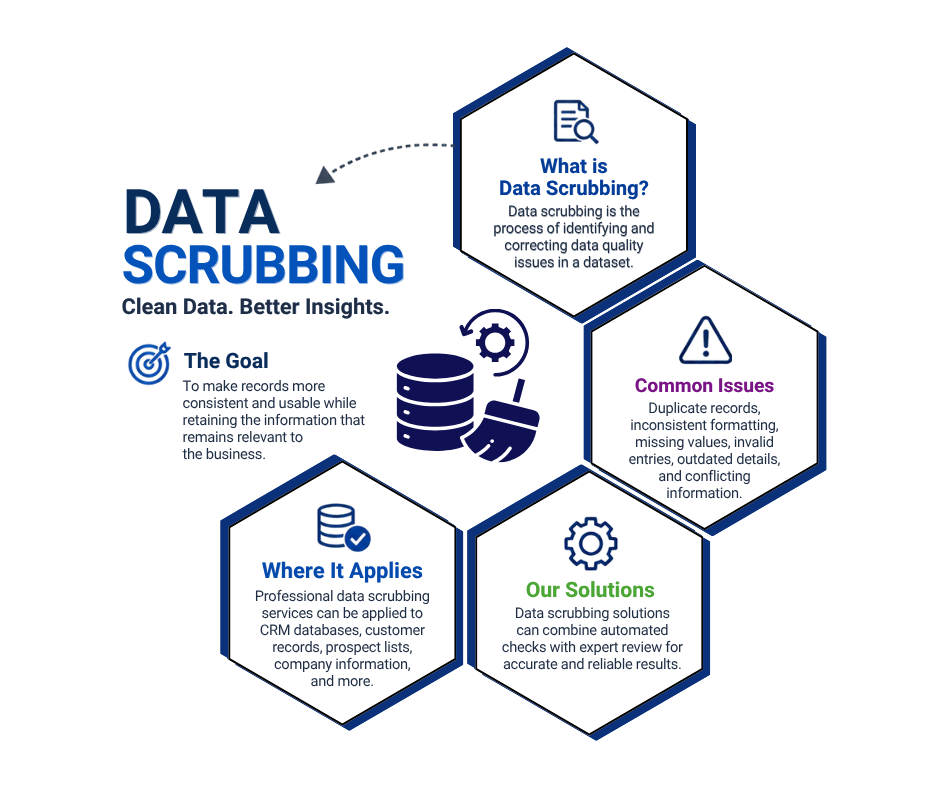
Data scrubbing is the process of identifying and correcting data quality issues in a dataset. These may include duplicate records, inconsistent formatting, missing values, invalid entries, outdated details, and conflicting information. The objective is to make records more consistent and usable while retaining the information that remains relevant to the business.
Professional data scrubbing services can be applied to CRM databases, customer records, prospect lists, company information, and other business datasets. The exact work depends on the source data and the agreed rules.
Data scrubbing solutions can combine automated checks with expert review. Automated processes are useful for applying consistent rules across large datasets, while complex records may require closer assessment before changes are made. Effective data cleansing and scrubbing should distinguish between errors that can be corrected confidently and information that needs review rather than automatically replacing uncertain values.
How Our Data Scrubbing Services Work?
Every data scrubbing project begins with an assessment of the source records and the quality issues that need to be addressed. BizProspex follows a six-step process to define the rules, review the data, and deliver a consistent dataset.
Step 1: Assess the Source Data
We review the dataset structure, available fields, record volume, and known data quality concerns. This establishes the scope of the project and identifies the checks required.
Step 2: Define Cleansing Rules
We agree on how to handle duplicates, inconsistent formatting, missing values, invalid entries, and conflicting information. Clear rules help maintain consistency throughout the process.
Step 3: Identify Data Quality Issues
Automated checks and structured comparisons help identify records that may contain errors, repeated entries, inconsistent fields, or values that do not meet the agreed criteria.
Step 4: Standardise and Correct Records
Where the required correction is clear, fields can be normalised and formatting inconsistencies addressed. Records that require additional information or a judgement call are flagged for review.
Step 5: Review and Validate Changes
Quality checks assess whether the changes follow the agreed rules and whether important source information has been retained. Duplicate handling and other material changes are reviewed against the project requirements.
Step 6: Deliver the Cleaned Dataset
The cleaned file is prepared in the agreed format, such as CSV or Excel. Where required, the output can include change indicators or review statuses to help your team assess the results before updating live systems.
Six Data Quality Issues That Undermine Your Database
Duplicate Contacts and Company Profiles
What happens: The same person or business appears under multiple entries because of variations in names, email addresses, company identifiers, or formatting.
How scrubbing helps: Matching rules identify potential duplicates for review and consolidation according to the agreed record-management process.
Outdated Job Titles and Contact Details
What happens: Existing records retain information that may no longer be current.
How scrubbing helps: Available validation and verification checks identify fields that need attention. Confirming current employment or contact details may require additional research or enrichment.
Invalid Email and Telephone Formats
What happens: Records contain malformed email addresses, inconsistent telephone formatting, or values that fail basic validation checks.
How scrubbing helps: Format checks flag invalid entries. Additional verification may be needed to establish whether an address or telephone number is active.
Inconsistent Company Names
What happens: Company names appear in different formats, abbreviations, or spellings across imported records, creating data inconsistencies.
How scrubbing helps: Standardisation rules align naming conventions while preserving distinctions between businesses that may have similar names.
Missing or Incomplete Fields
What happens: Important attributes are blank, partially entered, or recorded in an inconsistent format.
How scrubbing helps: The process identifies missing values and distinguishes formatting corrections from gaps that require additional information.
Conflicting Account Information
What happens: Different records contain inconsistent company names, addresses, identifiers, or associated contact details, making data matching difficult.
How scrubbing helps: Conflicting values are reviewed against available evidence and defined matching rules before corrections are applied.
What Poor Data Quality Costs Your Business?
Data quality problems can affect multiple workflows at once. Duplicate accounts may inflate database totals, inconsistent company names may split related records across reports, and missing fields may prevent teams from applying their intended filters. These issues can also complicate CRM migrations, database consolidation, and routine reporting.
Consider a business maintaining several files collected over time. One file uses abbreviated company names, another contains full legal names, and a third includes repeated records with slightly different formatting. Before combining these files, the organisation needs clear rules for identifying equivalent records and deciding which values to retain.
Professional database scrubbing services help businesses address these issues before they spread into additional systems or reporting workflows. The result depends on the accuracy of the source information and the rules agreed for handling conflicting records.

Eight Ways Cleaner Data Improves Daily Operations
Effective data scrubbing helps businesses make their existing information easier to manage and more useful across departments.
Reduce Duplicate Records
Identify repeated contacts and company entries to support cleaner account histories and reduce unnecessary duplication across databases.
Standardise Company and Contact Fields
Bring inconsistent names, titles, addresses, and other agreed fields into a consistent format for easier searching and reporting.
Improve CRM Segmentation
More consistent fields make it easier to organise records by role, company, account, or other available attributes.
Support More Reliable Reporting
Reduce discrepancies caused by duplicate entries, inconsistent categories, and poorly formatted values in business reports.
Prepare Records for Enrichment
Resolve existing data-quality issues before adding new information, helping businesses match records more consistently during enrichment.
Reduce Time Spent Correcting Records
Limit recurring cleanup work caused by preventable formatting issues, duplicate entries, and inconsistent database conventions.
Improve Database Matching
Standardise relevant fields and identify potential duplicates to support record matching across systems and datasets.
Simplify Migration and Integration
Prepare records for transfer between CRM systems, business databases, and other applications by addressing formatting and consistency issues before migration.
Industries That Benefit from Data Scrubbing Services
Organisations across industries maintain records from multiple systems, teams, and collection processes. Business data scrubbing helps address quality issues that can arise as these datasets grow.
Technology and Software
Technology businesses can standardise account fields, review duplicate company entries, and improve CRM consistency across customer and prospect records.
Financial and Professional Services
Financial firms and professional service providers can improve the consistency of business records used for reporting, account administration, and internal data management.
Manufacturing and Distribution
Manufacturers can review supplier, distributor, and buyer records for inconsistent company names, repeated entries, and incomplete business details.
Retail and E-commerce
Retailers can identify duplicate customer records, correct inconsistent product and supplier details, and maintain accurate, organized business data.
Healthcare and Pharmaceuticals
Organisations can maintain appropriate business and administrative datasets through defined validation rules, while observing applicable privacy and restrictions on sensitive information.
Marketing and Research Agencies
Agencies can standardise client-approved datasets before analysis, segmentation, or further enrichment, helping reduce inconsistencies in the source records.
What Automation Can Catch, and What Needs Review?
Automated data scrubbing tools can process large datasets consistently, particularly when the issues follow defined rules. More complex cases benefit from additional review.
Automated Checks
Best suited to repeatable rules and high-volume checks
- Detecting exact duplicate values.
- Identifying repeated email addresses or telephone numbers.
- Checking whether fields follow expected formats.
- Standardising capitalisation, spacing, and agreed naming conventions.
- Flagging missing values and inconsistent field types.
- Applying defined validation rules across large datasets.
Specialist Review
Useful when records require interpretation
- Assessing whether similar company names refer to the same organisation.
- Reviewing conflicting company identifiers or account information.
- Distinguishing genuine duplicates from separate individuals with similar details.
- Evaluating ambiguous record matches.
- Deciding how to handle exceptions to standard formatting rules.
- Reviewing changes that could affect record relationships or downstream systems.
Where AI-Assisted Scrubbing Fits?
AI-powered data scrubbing can help identify patterns, surface anomalies, and prioritise records that warrant attention. Machine learning data sanitation methods may also support classification and similarity-based matching when appropriately designed and tested.
However, automated predictions should not be treated as confirmed facts. Smart data scrubbing automation works best when supported by clear rules, suitable validation, and review procedures for uncertain results.
BizProspex combines research systems, automated checks, and specialist oversight according to the agreed requirements of the project. The objective is to produce records that are easier to use while keeping uncertain changes visible.
How Does Data Scrubbing Support Long-Term Business Growth?
Data quality changes over time as records are added, updated, merged, and transferred between systems. Periodic data scrubbing helps organisations identify recurring issues and apply consistent rules to the information they rely on. A repeatable process also makes it easier to determine which data quality problems require attention and which fields need clearer standards.
For businesses maintaining large or frequently updated databases, outsourcing data clean-up services can provide additional capacity for scheduled or project-based work. Defining the rules, documenting material changes, and reviewing exceptions can help teams maintain consistency as their data requirements evolve.

Why Businesses Choose BizProspex for Professional Data Scrubbing?
Data scrubbing requires more than removing obvious duplicates. It calls for clear rules, careful handling of ambiguous records, and a consistent approach to changes. BizProspex structures each project around the dataset and the quality requirements that matter to the client.
Project-Specific Cleansing Rules
We define the fields to review, the issues to address, and the rules for correcting or flagging records before the work begins.
Structured Data Quality Checks
Our approach uses systematic checks to identify repeated entries, inconsistent values, formatting issues, and fields that do not meet the agreed criteria.
Expert Review for Complex Records
Records with conflicting details or uncertain matches can be reviewed rather than changed automatically without sufficient evidence.
Organised Data Delivery
The cleaned dataset is prepared in an agreed format, with relevant source fields retained and changes or review statuses included where required.
Data Scrubbing vs. Data Cleansing vs. Data Enrichment
These services address related but distinct data requirements. Understanding the differences helps businesses select the right process for their databases.
Data Scrubbing
Data scrubbing services focus on identifying and addressing errors, duplicates, inconsistent formats, and other quality issues in existing records. The goal is to improve the consistency and usability of the information already available.
Data Cleansing
Data cleansing is a broader term for identifying and correcting, standardising, or removing inaccurate and unsuitable data. Data cleansing and scrubbing often overlap, and providers may use the terms interchangeably depending on the project scope.
Data Enrichment
Data enrichment adds information that is missing from or not currently included in a record. For example, a business may add company details, professional attributes, or contact information after scrubbing its existing database.
EXPERIENCE THAT DEFINES BIZPROSPEX
BizProspex brings over thirteen years of experience in research, data intelligence, and verification services. During this time, we have worked through regulatory change, evolving technology, and shifting data ecosystems while maintaining consistent delivery standards for clients worldwide.
Organisations work with us because they require reliable information, consistent research processes, and compliance handled correctly. Our methodology combines advanced research systems, multi-step data quality workflows, and experienced research specialists who assess accuracy beyond automated outputs. This balance of technology and expert oversight allows us to deliver information that supports real operational decisions.
Industry Leadership
Global specialists in research intelligence and business data verification
Experienced in identifying inconsistencies across complex business datasets
Providers of CRM scrubbing and database quality improvement solutions
Focused on duplicate identification, standardisation, and data review
Experienced in business data management and database enrichment workflows
Our Commitment
Our research specialists follow layered review processes that assess data consistency against agreed project rules. We identify duplicate candidates, examine conflicting values, standardise eligible fields, and flag records that require further assessment. Where the available information does not support a confident correction, the record can be retained for review instead of being changed without sufficient evidence.
What Our Clients Say
Our CRM had accumulated inconsistent company names and repeated entries over several years. The project gave us a clearer way to review those issues and apply consistent formatting rules to the records.
Rowan Mitchell
We were preparing several datasets for consolidation and needed a consistent approach to duplicates and missing fields. Defining the rules upfront helped us understand how the records would be handled.
Aisha Rahman
Our priority was to identify quality issues before moving records into a new system. The organised output helped us separate straightforward corrections from records that needed further review.
Felix Andersson
We needed to standardise selected fields across records maintained by different teams. The agreed cleansing criteria gave us a consistent basis for reviewing the information.
Simone Baptiste
The source files had accumulated different naming conventions and repeated entries. The review helped us identify the issues that needed attention before the next stage of database maintenance.
Vikram Chatterjee
We wanted to understand which records were inconsistent and what action each issue required. Having the results organised by issue made the follow-up process easier to manage.
Lucia Moretti
Get Your Free Sample Data
Before investing in professional data scrubbing, review how the proposed process identifies inconsistencies, handles duplicates, and distinguishes straightforward corrections from records requiring further assessment.
Request a complimentary sample review to understand the output format and the types of data quality issues that can be addressed. Depending on the agreed scope, the sample may demonstrate duplicate identification, field standardisation, missing-value flags, formatting corrections, and review statuses.
A sample can help you evaluate the proposed process before defining the full project.
Request a Free Sample
Download Free SampleGet the Exact Data Quality Support You Need
Inconsistent records and duplicate entries can make business databases harder to manage and maintain. BizProspex provides data scrubbing services to help organisations identify data quality issues, apply agreed cleansing rules, and prepare more consistent datasets.
Whether you need CRM data scrubbing, B2B database cleanup, or a broader data hygiene review, our team can help define the fields, rules, and deliverables for your project.
Frequently Asked Questions
What types of issues can data scrubbing services address?
Data scrubbing services can address duplicate records, inconsistent formatting, missing values, invalid field entries, and conflicting information. The exact checks depend on the dataset and the rules agreed for the project. Issues that cannot be resolved confidently should be flagged for review.
What is the difference between data scrubbing and data deduplication?
Data deduplication focuses on identifying and handling repeated records. Data scrubbing covers a broader range of quality issues, which may include duplicates, formatting inconsistencies, missing values, and invalid entries. Deduplication can therefore be one component of a data scrubbing project.
How does data scrubbing help before a CRM migration?
CRM data scrubbing helps identify inconsistent fields, repeated entries, and incomplete records before information is transferred to another system. Addressing these issues early can make field mapping and reconciliation easier. The work should follow the destination system’s data requirements and the organisation’s retention rules.
What is real-time data scrubbing?
Real-time data scrubbing refers to checking or standardising information as it enters or changes within a system. It may be implemented through validation rules or integrated data processes. Whether it is appropriate depends on the available systems and whether checks need to happen during data entry or in scheduled batches.
Can automated data scrubbing tools handle every data quality issue?
No. Automated checks can efficiently detect repeated patterns, formatting differences, and values that fail defined rules. However, ambiguous company matches, conflicting records, and context-dependent errors may need expert assessment. The appropriate balance depends on the dataset and the consequences of an incorrect change.
How do predictive data scrubbing solutions work?
Predictive data scrubbing solutions may use patterns in existing records to flag likely errors, anomalies, or possible duplicates for review. These predictions indicate where an issue may exist; they do not independently prove that a record is incorrect. Appropriate review rules are still needed.
Is machine learning data sanitation different from traditional scrubbing?
Machine learning data sanitation may use learned patterns to detect anomalies or identify records that resemble known errors. Traditional rule-based scrubbing applies explicitly defined conditions. Some workflows combine both approaches, with expert review for cases where the correct action is uncertain.
How does automated CRM data scrubbing improve data accuracy?
Automated CRM data scrubbing can apply consistent validation and formatting rules across many records, helping identify duplicates and values that do not meet defined criteria. Accuracy still depends on the quality of those rules and the handling of exceptions. Automated processing should not be treated as proof that every resulting record is correct.
What is the ROI of data scrubbing compared with manual cleanup?
The data scrubbing vs manual cleanup ROI depends on dataset size, issue complexity, labour requirements, and the cost of errors. Automated checks can reduce repetitive work, while expert review remains important for ambiguous records. A useful assessment compares total project cost with the time saved and the impact of improved data consistency.
What is the difference between data cleanup services and database scrubbing services?
Data clean up services and database scrubbing services often overlap. Both may address duplicates, missing values, formatting inconsistencies, and other data quality issues. The important distinction is the agreed scope, the rules used, and the output the provider delivers rather than the label alone.
What is the difference between smart database scrubbing and data enrichment?
Smart database scrubbing refers to applying structured or technology-assisted methods to identify and address data quality issues. Data enrichment adds information that is not already present. The two processes can be combined, but they should have separate requirements so the business can distinguish corrections from newly added information.
How are data scrubbing pricing and project scope determined?
Project scope depends on record volume, data complexity, the number of fields being reviewed, the types of quality issues involved, and the level of expert review required. Businesses should define the expected corrections, duplicate-handling rules, and delivery format before requesting a quotation.
Can CRM data scrubbing be completed without losing important information?
Yes, provided the project defines how records and conflicting values should be handled. Original identifiers can be retained, and uncertain cases can be flagged rather than automatically overwritten or removed. Businesses should review material changes before applying them to live CRM systems.
What is the difference between data scrubbing and data enrichment?
Data scrubbing improves the consistency and quality of information already present. Data enrichment adds new information to existing records. A business may scrub a database first to address duplicates and inconsistent fields, then enrich eligible records with additional company or contact details.
What role can AI-powered data scrubbing play?
AI-powered data scrubbing may help identify patterns, suggest potential matches, classify common data issues, or prioritise records for review. Its effectiveness depends on the input data, methods used, and quality controls. Suggested corrections should be assessed before being applied when an error could alter important business information.
What should businesses consider when comparing data scrubbing tools in 2026?
When comparing the best data scrubbing tools in 2026, assess the data formats supported, duplicate-matching options, field standardisation, auditability, integration requirements, and handling of uncertain records. Also consider whether the business needs software for ongoing internal use or a service provider for a defined project.
What are intelligent data cleanup tools used for?
Intelligent data cleanup tools help detect, classify, or correct data quality issues using rules, pattern recognition, or other automated methods. Their suitability depends on the type of data, the complexity of the problems, and the controls available to review proposed changes.
How can businesses maintain clean CRM data after a scrubbing project?
Tips for maintaining clean CRM data include defining standard field formats, validating information at entry, applying consistent duplicate rules, assigning ownership for data quality, and reviewing recurring errors. Scheduled checks can help identify issues before they accumulate across the database.
Can B2B data scrubbing improve a prospect database?
B2B data scrubbing can help identify repeated company records, standardise business fields, and flag missing or inconsistent values. It does not automatically add missing information or establish that all existing details are current. Additional enrichment or verification may be required for those objectives.
How can I prepare a dataset for professional data scrubbing?
Identify the fields that matter, preserve record IDs, explain known data issues, and specify how duplicates and conflicting values should be handled. If several files are involved, clarify whether they need to be assessed separately or compared against one another. These details help define the cleansing rules and final output.
What is included in data hygiene and scrubbing?
Data hygiene and scrubbing may include duplicate identification, standardisation, validation checks, missing-field review, and exception reporting. The specific deliverables depend on the project scope. Businesses should agree on the fields, rules, and review process before the work begins.
Can data scrubbing remove every duplicate automatically?
Not safely in every case. Two records may appear similar but refer to different companies or individuals, while the same entity may be represented using different names. Matching rules should reflect the dataset, and ambiguous cases should be reviewed before records are merged or removed.